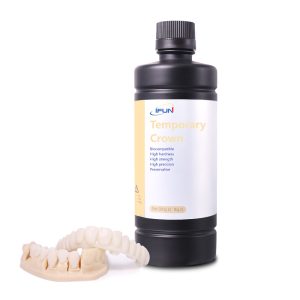
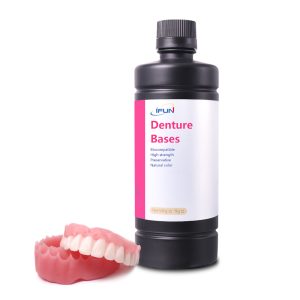
In additive manufacturing dentistry, the transition from theoretical application to clinical excellence depends on two factors: the chemical composition of the denture base resins and the precision of the production workflow. For dental laboratories, achieving long-term stability requires more than just high-resolution hardware; it demands a deep understanding of photopolymerization and the aging effect on 3D printed dental resins.

1. Strategic Material Selection: Evaluating Resin Chemistry
Not all resins are equal. When selecting a material for a 3D printed denture base, laboratories must look beyond basic mechanical strength and evaluate the following technical criteria:
- Monomer Conversion Rate: High-quality resins should achieve a high degree of conversion during light curing to minimize residual monomers, which directly impacts biocompatibility and water absorption of 3D printed dentures.
- Filler Integration: Look for resins enhanced with nano-fillers (such as Zirconia or Graphene). These additives improve the density of the Poly(methyl methacrylate) / PMMA derivatives, significantly reducing water sorption and solubility.
- Viscosity and Printability: Lower viscosity resins often allow for better self-leveling during the printing process, reducing the risk of micro-voids between layers that can trap stains.
2. Optimizing Printing Parameters for Structural Integrity
The long-term stability of a prosthetic is often determined by the orientation of the print on the build plate. Clinical data suggests that printing at a 90-degree or 45-degree angle can yield superior results compared to horizontal printing.
- Layer Thickness: While thinner layers (e.g., 50 microns) increase printing time, they result in a denser surface with fewer “stair-step” artifacts. This smoothness is critical for maintaining color stability and preventing the colonization of Candida albicans.
- Build Orientation: Vertical printing (90°) often provides higher flexural strength and more predictable shrinkage rates. This is essential for the fit of the 3D printed denture base at the posterior palatal seal.
3. The Critical Post-Processing Path: Achieving Peak Performance
The most common cause of failure in additive manufacturing dentistry is inadequate post-processing. To match or exceed the performance of milled denture bases, labs must follow a strict validation protocol:
A. Solvent Management (Cleaning)
Excess liquid resin must be removed using high-purity Isopropyl Alcohol (90%+) or specialized cleaners. However, excessive soaking (over 5 minutes) can degrade the polymer surface, increasing water sorption and solubility over time. Ensure the part is completely dry before the final cure.
B. Validated UV Post-Curing
This is where the final mechanical properties are “locked in.” Without optimized photopolymerization, the denture will remain “under-baked,” leading to significant Delta color change when exposed to coffee or tea.
- Temperature Control: Curing in a heated UV chamber (e.g., 60°C) accelerates the reaction and ensures deeper light penetration.
- Atmospheric Curing: Some high-end resins benefit from curing in a nitrogen-rich environment to eliminate the oxygen-inhibition layer, resulting in a harder, more stain-resistant surface.
4. Managing Long-term Stability and Aging
To answer the clinician’s question—”How long do 3D printed dentures last?”—labs must simulate thermocycling aging in their quality control. A well-processed 3D printed resin should maintain a $\Delta E$ below the clinical threshold of 2.7 after simulated one-year oral exposure.
| Parameter | Standard Processing | Optimized Protocol (Recommended) | Clinical Benefit |
|---|---|---|---|
| Post-Cure Time | Short (5-10 mins) | Standardized (20-30 mins at 60°C) | Lower Solubility & Higher Hardness |
| Surface Finish | Manual Sanding | Mechanical Polishing + Nano-Glaze | Superior Color Stability |
| Print Angle | Horizontal (0°) | Vertical (90°) | Higher Accuracy & Flexural Strength |
5. Summary for Laboratory Technicians
Achieving a “perfect” 3D printed prosthetic is a matter of balancing chemistry and physics. By selecting resins with high conversion potential and strictly adhering to validated cleaning and UV-curing cycles, dental laboratories can produce 3D printed denture bases that rival the long-term stability of any traditional CAD/CAM method. The focus must always be on reducing surface porosity to mitigate the aging effect on 3D printed dental resins.