This passage mainly introduces common types of light – curing printing resins and their characteristics and applications
Common types of light – curing printing resins
Ordinary rigid resin
Ordinary rigid resin is the most common light – curing printing resin, widely used and available in a variety of colors, such as orange, green, red, yellow, blue, white, etc. The parts printed with it generally have a smooth and delicate texture and high hardness. However, the parts are quite brittle and prone to breakage and cracking. It is suitable for beginners and the production of ornaments, prototypes, small statues, etc. It is also a relatively basic choice in resin 3D printing.
Hard (high – strength) resin
Hard resin was developed according to market demand to overcome the problems of photosensitive resin being fragile and prone to breakage and cracking. It has a stronger and more durable shape and performs well in terms of impact and shock resistance. It is often used in the production of prototypes of precision – assembled parts or snap – fit joint prototypes, where high strength and stability are required.
Investment casting resin
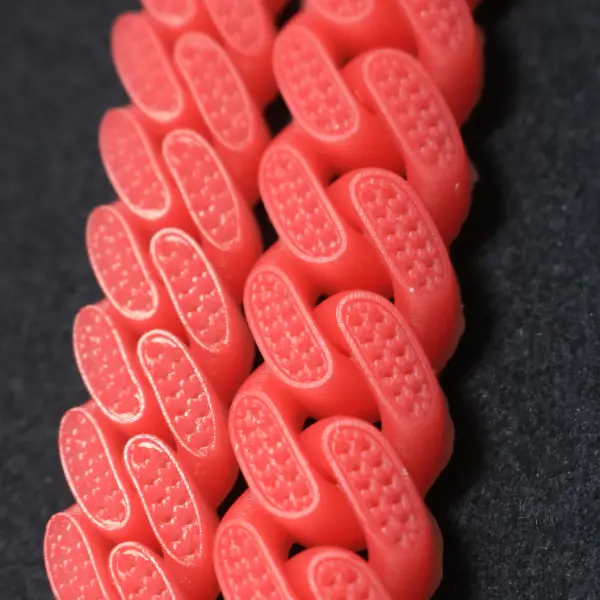
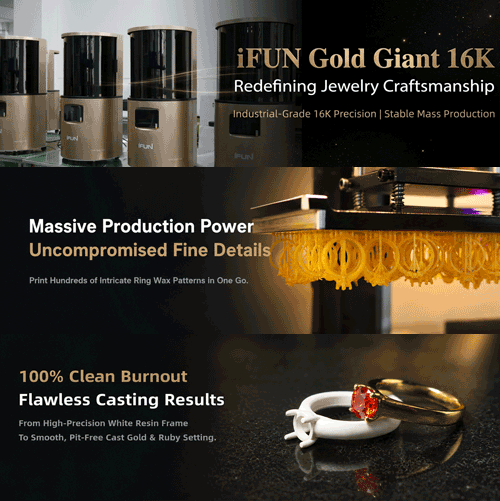
Investment casting resin is used in situations where traditional processes are time – consuming and the freedom of mold design for jewelry is limited. The expansion coefficient of this resin is not highly required. During the combustion process, the polymer burns away, leaving the final product. It is suitable for applications in investment casting processes, such as the production of some special jewelry manufacturing molds or casting prototypes with high shape requirements.
Flexible resin
Flexible resin has properties similar to rubber, with a Shore hardness of about 80A. The advantage of this resin is that it can create high – strength objects that can bend and compress without deformation and can return to their original shape after being compressed. It has a long service life and can withstand continuous use without breaking. Therefore, it is often used in the manufacture of parts that require deformation and elasticity, such as shock absorbers, handles, or prototypes of moving parts.
Water – washable resin
Compared with other resins, water – washable resin has unique advantages in post – printing processing. Generally, resin 3D – printed parts need to be post – processed with isopropyl alcohol (IPA) to remove supports and excess resin. However, water – washable resin does not require chemical treatment. Simply washing the parts with water can result in a smoother and more comfortable touch, while reducing stickiness and odor. However, its accuracy may be affected to some extent, and the price of this resin is usually slightly higher than that of standard resins produced by the same manufacturer, and the color options are sometimes relatively limited.
Transparent resin
Transparent resin is colorless, transparent, and has high gloss, capable of printing works like crystal. While maintaining high transparency, it also exhibits good mechanical strength and corrosion resistance. This resin can be used in multiple fields such as electronic components, handicrafts, and buildings to manufacture small objects with high precision. It plays a role when creating glass – like effects or requiring transparent parts. However, it is not recommended for use in the food field, but the printed parts can be applied in the waterproof field.
Industrial resins (including heat – resistant, combustible, and dental resins, etc.)
- Heat – resistant resin: It can withstand high temperatures. The parts created with it can be exposed to temperatures as high as 230°C without affecting their shape and performance. It is very suitable for the production of products with temperature – resistance requirements, such as casting tools, tools exposed to hot liquids, and equipment exposed to intense heat.
- Combustible resin: It is often used in scenarios where metal casting is required after model design and printing. The combustible resin will evaporate during this process, leaving no ash or residue, thus keeping the surface of the final object clean and smooth. It is commonly used in the jewelry and dental restoration fields to ensure good appearance of the parts.
- Dental resin: It is composed of non – toxic organic elements and can be used in dental applications without endangering the health of patients, such as the manufacture of retainers, crowns, bridges, surgical models, dentures, or anatomical models and other dental applications. It can also significantly reduce the production cost of traditional dental restorations.